
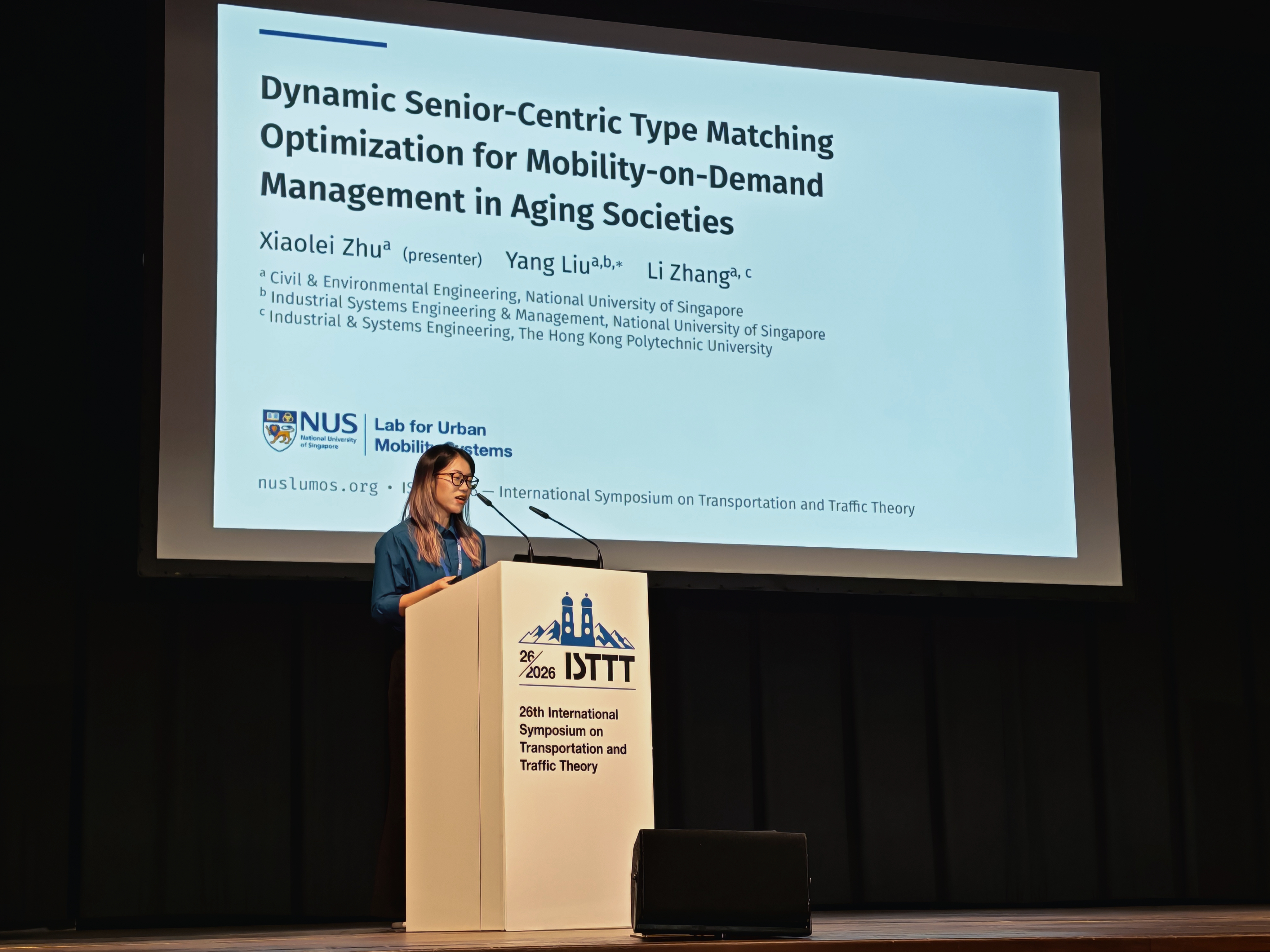
Title: Dynamic Senior-Centric Type Matching Optimization for Mobility-on-Demand Management in Aging Societies
Authors: Xiaolei Zhu, Yang Liu*, Li Zhang
Abstract: We study a dynamic type-matching problem in mobility-on-demand (MoD) systems where multiple passenger segments have differentiated mobility requirements and multi-type vehicle fleets exhibit asymmetric service compatibilities. This general structure arises naturally whenever a specialized vehicle type is exclusively reserved for a high-priority demand segment and must be prioritized accordingly. Motivated by the mobility challenges of aging societies, we instantiate this structure in a senior-centric MoD context, incorporating Wheelchair Accessible Vehicles (WAVs) as a complementary fleet component dedicated to serving seniors with accessibility needs. The resulting type-matching problem features multi-type fleets, differentiated passenger segments, and asymmetric compatibilities, necessitating the development of heterogeneous yet interdependent fleet policies. We formulate the problem as a stochastic dynamic program that embeds accessibility and priority principles, and develop a Fleet-Decomposable Markov Game (Fleet-Dec MG) to model coordinated decisions among fleets with asymmetric roles. We establish a sequential fleet-based value decomposition property that preserves the long-run objective while respecting feasibility coupling between fleet policies. Building on this, we propose a Fleet-Decomposable Trust-Region Policy Optimization (FDTRPO) algorithm as a theoretical solution to the proposed Fleet-Dec MG. We prove that FDTRPO has monotonic improvement properties and converges to a Trust-Region Nash equilibrium. To enable scalable real-time deployment, we further develop a Fleet-Decomposable Proximal Policy Optimization (FDPPO) algorithm. Through city-scale experiments on real-world taxi data, we demonstrate that FDPPO converges smoothly in a high-dimensional, stochastic environment and yields deployable policies that enhance both efficiency and fairness. Compared with advanced learning benchmarks, the optimal FDPPO policy achieves a 2.6% increase in system profit and boosts the order fulfillment rate for senior passengers to over 90% with an improvement of nearly 9 percentage points for those with accessibility needs, while the levels of service of other segments are also improved. We also derive managerial insights for operators aiming to expand accessible and inclusive services for seniors and passengers with disabilities. Overall, this work advances a theoretically grounded yet practical paradigm for the dynamic type-matching problem with asymmetric compatibilities and interdependent fleet coordinations.
Key Words: Dynamic Type Matching Optimization, Dynamic Mobility-on-Demand Management, Senior Mobility, Multi-agent Cooperative Markov Game, Trust-Region Reinforcement Learning

Paper Link: